Vedic (Jyotish) and Western astrology share the same twelve zodiac sign names and many planetary concepts, yet they often give the same person a different sign. The reason is not a disagreement about the sky but a choice of where to start counting the zodiac. This guide explains that difference, the other ways the two systems work, and what it means for your own chart.
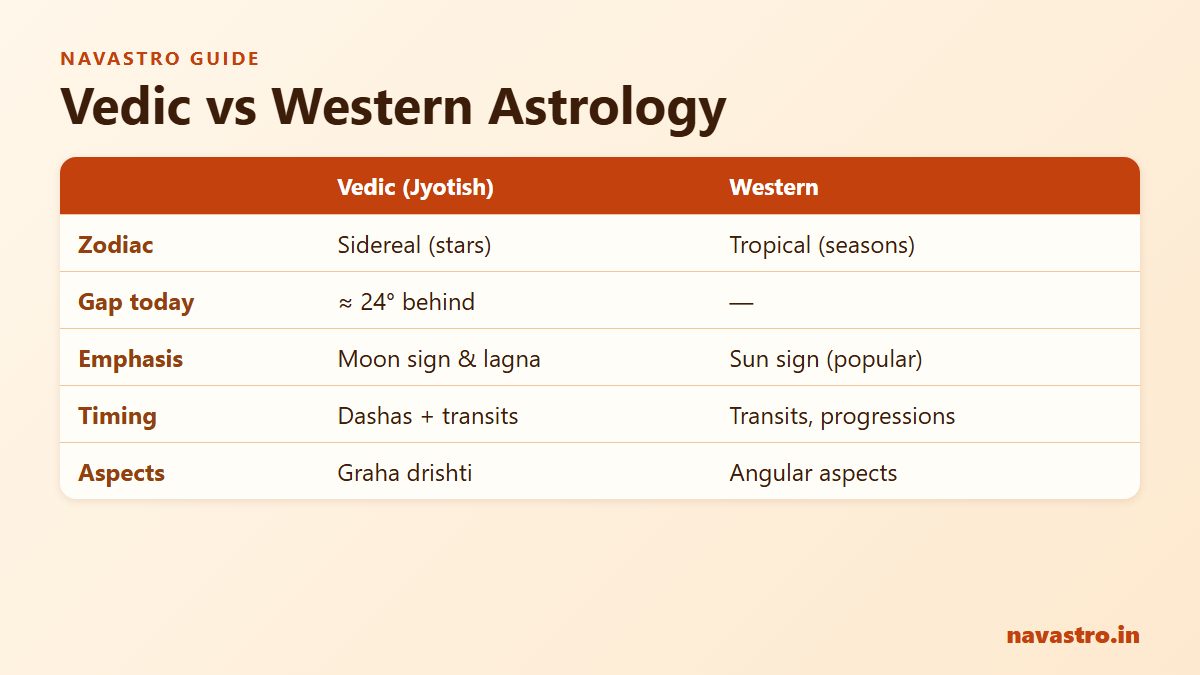
Quick answer: Vedic astrology uses the sidereal zodiac, fixed to the stars; Western astrology uses the tropical zodiac, fixed to the seasons. The two are now about 24° apart, so roughly four Sun positions in five fall in a different sign in each system. Vedic astrology also puts the Moon, nakshatras and dashas at the centre; popular Western horoscopes focus on the Sun sign, while full Western natal astrology also reads the Moon, Ascendant, houses and aspects.
See your Vedic chart. The free Kundli calculator gives your sidereal Lagna, Moon sign, nakshatra and dashas. No sign-up.
The main differences
| Vedic (Jyotish) | Western | |
|---|---|---|
| Zodiac | Sidereal: fixed to the stars | Tropical: 0° Aries at the spring equinox |
| Offset today | — | About 24° ahead of sidereal |
| Common emphasis | Moon sign (rashi) and lagna | Sun sign in popular horoscopes; Moon, Ascendant and aspects in natal astrology |
| Planets used | Classical Jyotish primarily uses the seven visible planets plus Rahu and Ketu | Modern Western astrology commonly includes Uranus, Neptune and Pluto alongside the traditional planets |
| Timing | Dashas (Vimshottari and others) | Transits and progressions |
| Aspects | Graha drishti: every planet aspects the 7th sign from itself; Mars also the 4th and 8th, Jupiter the 5th and 9th, Saturn the 3rd and 10th | Angular aspects: conjunction, sextile, square, trine, opposition |
| Extra tools | 27 nakshatras, divisional charts (D9, D10…) | Asteroids, midpoints |
| Houses | Usually whole signs | Usually Placidus or other quadrant systems |
Sidereal vs tropical: why your sign moves
Both systems divide the ecliptic into twelve 30° signs. The tropical zodiac starts at the point where the Sun crosses the equator in March (the spring equinox). The sidereal zodiac uses a star-referenced starting point. In the Lahiri (Chitrapaksha) system used by most Indian panchangs, the star Spica (Chitra) marks about 0° Libra, so 0° Aries lies opposite it. Other ayanamsa systems use slightly different reference points.
Because the Earth's axis slowly wobbles (precession), the equinox point drifts backwards through the stars by about 50 seconds of arc a year. The gap between the two zodiacs, the ayanamsa, is about 24°14′ at the start of 2027 with the Lahiri ayanamsa, and grows by about 50″ a year, roughly one degree every 72 years. Since a sign is 30° wide, a tropical position below roughly 24° within its sign will generally fall in the preceding sidereal sign. That is why the Sun's sign differs for roughly four out of five possible zodiac positions, and why someone can be a Leo in Western astrology but a Cancer in Vedic astrology.
Different priorities
Vedic astrology is built around the Moon and the lagna: the Moon sign is especially important in rashifal and Sade Sati, and kundli matching uses the Moon's nakshatra along with other chart factors. In Vimshottari Dasha, the Moon's birth nakshatra determines the starting planetary period and the remaining balance of that period at birth. Predictions are timed mainly with dashas, planetary periods that run through a lifetime, refined by transits.
Western astrology in popular horoscopes focuses on the Sun sign. Full Western natal astrology also reads the Moon, the Ascendant, planetary placements, houses and angular aspects such as conjunctions, trines and squares. It commonly includes the outer planets, which classical Vedic astrology leaves out, and times events with transits and progressions.
A worked example
A sample birth (not a real person): 12 August 1994, 6:40 am, Lucknow. Both columns come from NavAstro's chart engine with the same settings; the Lahiri ayanamsa at that moment was 23°47′.
| Tropical (Western) | Sidereal (Vedic) | |
|---|---|---|
| Sun | Leo 19°07′ | Cancer 25°20′ |
| Moon | Libra 20°06′ | Virgo 26°19′ |
| Ascendant | Virgo 2°13′ | Leo 8°25′ |
Each position is the same point in the sky; only the starting line differs. Subtracting 23°47′ moves the Sun from 19° Leo back to 25° Cancer, the Moon from 20° Libra to 26° Virgo, and the Ascendant from Virgo 2°13′ back to Leo 8°25′.
The table is rounded to the minute, so subtracting the rounded figures can be off by 1′. The exact values are: ayanamsa 23°47′25″, Ascendant Virgo 2°12′40″ (tropical) and Leo 8°25′15″ (sidereal).
Which is right?
Neither zodiac is inherently a mistake; they use different reference points. If you follow traditional Vedic astrology, use a sidereal chart, because its rules, including nakshatras, dashas and Sade Sati, are based on the sidereal zodiac. Similarly, apply Western techniques with the zodiac and conventions of the Western system.
Frequently asked questions
Why is my sign different in Vedic astrology? Vedic astrology uses the sidereal zodiac, which is about 24° behind the tropical zodiac. A planet in the first 24° of a Western sign usually falls in the previous sign in the Vedic chart.
Which is more accurate, Vedic or Western astrology? Vedic astrology commonly uses planetary dashas and transits for predictive timing, while many Western astrologers emphasise psychological interpretation alongside predictive techniques. Neither system can be scientifically established as more accurate than the other.
What is the ayanamsa? The angle between the tropical and sidereal zodiacs, about 24° today. Different schools use slightly different values (Lahiri, KP, True Chitra Paksha and others); NavAstro uses Lahiri by default.
Do Vedic astrologers use Uranus, Neptune and Pluto? Traditionally no. Classical Vedic astrology uses the seven visible planets plus Rahu and Ketu, the lunar nodes.
Is the Vedic Sun sign the same as my rashi? No. Your rashi is your Moon sign. Your Vedic Sun sign is the sidereal sign of the Sun.
Can I use both systems? Yes, as long as you keep each system's rules with its own zodiac.
To compare your own Western Sun sign with your Vedic Sun and Moon signs, use the Zodiac Sign by Date of Birth finder and the free Kundli calculator.
Related reading: Sun Sign vs Moon Sign vs Ascendant · Zodiac Sign by Date of Birth · How to Read a Kundali · Your sidereal chart in the free Kundli calculator
This article is for general information about Vedic astrology. It is not professional advice.