In astrology, three important signs in your birth chart are the Sun sign, Moon sign and ascendant, and they are often different. Your Sun sign is the sign the Sun was in when you were born, your Moon sign (rashi) is the sign of the Moon, and your ascendant (lagna) is the sign rising on the eastern horizon at that moment. Magazines print Sun-sign horoscopes; Indian astrology is built mostly on the other two. This guide explains what each one shows and which to use when.
Quick answer: in Vedic astrology the ascendant and the Moon sign are especially important: the ascendant establishes the houses of the birth chart, while the Moon sign is central to rashifal, Sade Sati and several predictive techniques. The Sun sign, traditionally linked with vitality and drive, remains an important supporting factor.
Find all three in seconds. The free Kundli calculator shows your Lagna, Moon sign (rashi) and Sun sign; the Moon Sign calculator gives just your rashi and nakshatra. No sign-up.
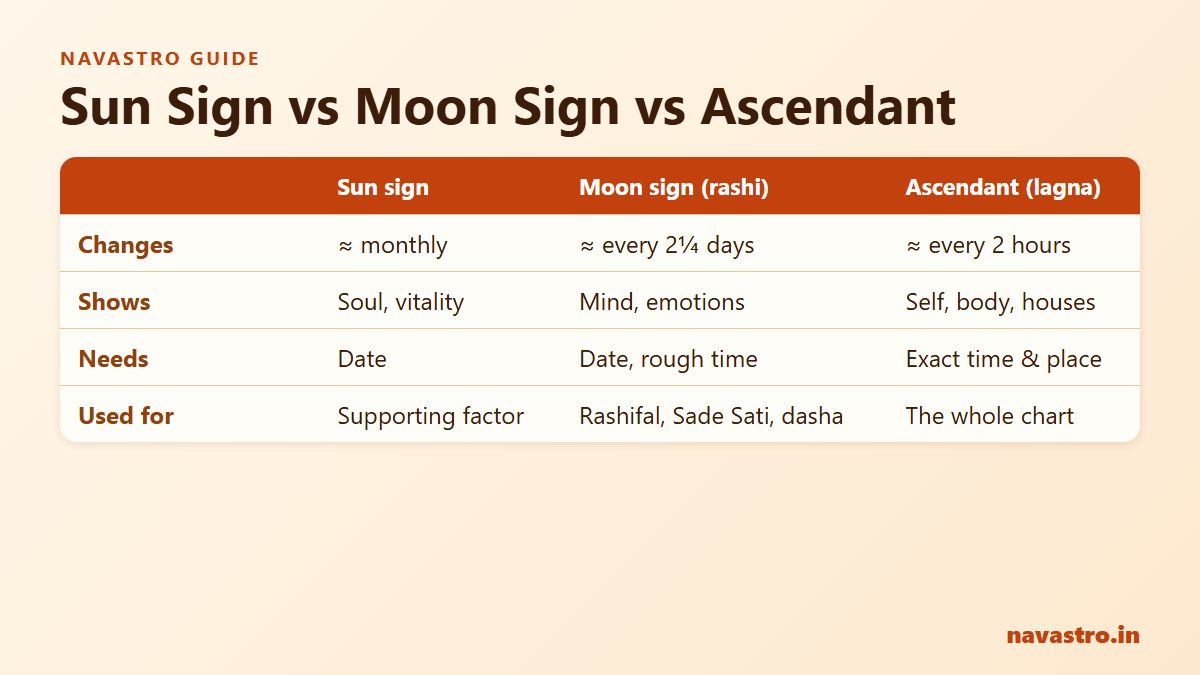
The three signs at a glance
| Sun sign | Moon sign (rashi) | Ascendant (lagna) | |
|---|---|---|---|
| What it is | The Sun's sign at birth | The Moon's sign at birth | The sign rising in the east at birth |
| How often it changes | About once a month | About every 2¼ days | About every 2 hours |
| What you need to know it | Date of birth | Date, roughly the time | Exact time and place |
| Traditionally associated with | Soul, vitality, father, authority | Mind, emotions, mother, daily life | Body, personality, direction of life |
| What Indian astrology uses it for | Supporting factor (Surya lagna) | Rashifal, Sade Sati, nakshatra-based dashas, matching | The houses of the whole chart |
The ascendant (lagna): the frame of the chart
The ascendant is the most personal of the three. It typically changes sign about every two hours, although the exact duration varies with the place of birth and the sign rising. It is the 1st house, and every other house is counted from it, so it decides which sign falls in the house of marriage, career, money and so on. It is traditionally associated with the body, temperament and the overall direction of life. Because it needs an exact time, it is also the most often wrong when a birth time is guessed. More in How to Read a Lagna Chart.
The Moon sign (rashi): the sign Indian astrology talks about
When an Indian astrologer, a newspaper rashifal or a wedding card says "your rashi", it means the Moon sign. The Moon is the mind, and the sign it occupies colours how you feel and react. It also does a great deal of practical work:
- Daily, monthly and yearly rashifal are read by house from the Moon sign.
- Sade Sati and Shani's Dhaiya are counted from the Moon sign.
- The Moon's birth nakshatra (one of 27 star divisions) determines the starting Vimshottari dasha and the balance of it remaining at birth.
- Kundli matching (Ashtakoot) compares the two Moon signs and nakshatras.
The Sun sign: the Western favourite
In Western astrology the Sun sign is the headline because it only needs a date. In Vedic astrology the Sun is the soul and the source of vitality, authority and the father, and charts are sometimes read from the Sun as a third reference (Surya lagna), but it is rarely the starting point. One more twist: Vedic and Western astrology use different zodiacs, so even your Sun sign is usually different between the two systems. See Vedic vs Western Astrology.
A worked example
A sample birth (not a real person): 12 August 1994, 6:40 am, Lucknow, calculated with NavAstro's chart engine using the Lahiri ayanamsa for the Vedic column and the tropical zodiac for the Western column:
| Vedic (sidereal) | Western (tropical) | |
|---|---|---|
| Ascendant | Leo | Virgo |
| Moon sign | Virgo (nakshatra Chitra) | Libra |
| Sun sign | Cancer | Leo |
All three placements differ by one zodiac sign between the sidereal and tropical systems. A Vedic astrologer would read this person through a Leo lagna (dignity, wish to lead) and a Virgo Moon (a precise, detail-minded mind), with the Sun in Cancer in the 12th house as a supporting note. Someone reading a Western Sun-sign column would be reading "Leo", which in the Vedic chart is the lagna, not the Sun.
Which one should you use?
- For your personality and the houses of life: the ascendant.
- For rashifal, Sade Sati, dashas and kundli matching: the Moon sign.
- For a quick, date-only reading: the Sun sign, knowing it is the least personal of the three.
- If you don't know your birth time: use the Moon sign. It changes only every two and a quarter days, so the date and place usually settle it, unless the Moon changed sign on your birth date.
Frequently asked questions
Which is more accurate, the Sun sign or the Moon sign? In Vedic astrology, the Moon sign is especially important for understanding the mind and reading rashifal. The ascendant provides the framework for interpreting the entire birth chart, while the Sun sign contributes information about vitality, identity and authority.
Is my rashi my Sun sign or my Moon sign? Your rashi is your Moon sign: the sign the Moon occupied when you were born.
Why is my zodiac sign different in Indian astrology? Indian astrology uses the sidereal zodiac, which today is about 24° behind the tropical zodiac used in Western astrology, so many people have a different Sun sign in the two systems.
Can the ascendant and Moon sign be the same? Yes. The Moon sign and ascendant are the same when the Moon occupies the sign rising on the eastern horizon at birth.
What if I don't know my birth time? You may still be able to find your Moon sign from your birth date and place. If the Moon changed sign on your birth date, the exact birth time is needed to confirm it; the free Moon Sign calculator tells you when that is the case.
Is the ascendant the same as the rising sign? Yes. Ascendant, rising sign and lagna all mean the sign rising on the eastern horizon at birth.
Related reading: Zodiac Sign by Date of Birth · Vedic vs Western Astrology · How to Read a Kundali · Find your signs in the free Kundli calculator
This article is for general information about Vedic astrology. It is not professional advice.